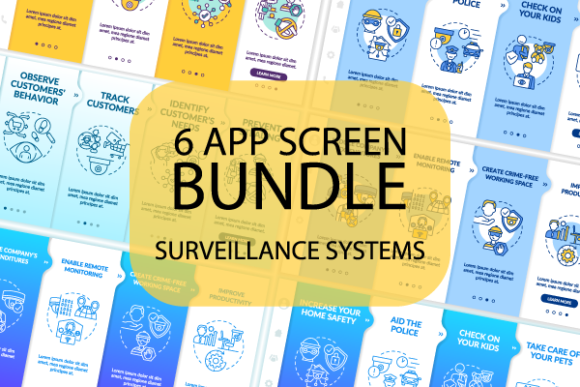
Optimizing Security UI Design with the Surveillance Systems App Screens Bundle
In the rapidly evolving landscape of physical security and digital monitoring, the user interface serves as the critical bridge between complex data streams and human decision-making. Whether managing a small retail outlet or overseeing a multi-site corporate campus, the effectiveness of a surveillance system is often dictated by the clarity and responsiveness of its control panel. For designers, developers, and security integrators, creating these interfaces from scratch presents a significant challenge in balancing aesthetic appeal with functional urgency. This is where specialized design resources, such as the Surveillance Systems App Screens Bundle, become indispensable tools for accelerating workflow while maintaining high standards of usability.
The modern security environment demands more than just camera feeds; it requires intuitive navigation, real-time alert management, and seamless onboarding experiences. A well-structured interface can mean the difference between a swift response to a security breach and a missed opportunity to prevent loss. By leveraging pre-designed assets like the surveillance systems webpage app screens bundle, professionals can focus on customization and integration rather than reinventing the wheel for every new project. These resources provide a foundational framework that adheres to industry best practices, ensuring that the final product is both visually compelling and operationally robust.
The Critical Role of Interface Design in Modern Security
Security operations centers and mobile monitoring apps handle vast amounts of visual information. The primary goal of any surveillance interface is to reduce cognitive load for the operator. When an alarm triggers, the user must be able to identify the threat, locate the specific camera feed, and initiate a response protocol within seconds. Cluttered layouts, confusing iconography, or slow navigation can lead to critical delays. Consequently, the design philosophy behind these systems must prioritize clarity above all else.
This is particularly evident in the concept of crime protection color concepts. Effective security interfaces often utilize a specific palette designed to evoke alertness without causing panic. High-contrast colors are used to highlight active threats, while neutral tones maintain a calm background for continuous monitoring. Linear illustrations and vector templates help simplify complex schematics, making it easier for users to understand floor plans and camera coverage areas at a glance. The use of standardized icons ensures that functions like "pan," "tilt," "zoom," and "record" are universally understood, regardless of the operator's language or technical background.
Furthermore, the shift toward mobile-first security management has made responsive design non-negotiable. Security personnel are no longer tethered to a desktop workstation; they need access to live feeds and historical data on tablets and smartphones. A responsive mobile website with icons ensures that the interface scales correctly across different screen sizes, maintaining functionality whether viewed on a large monitor in a control room or a handheld device during a patrol. This adaptability is crucial for modern retail onboarding and remote management scenarios.
Streamlining Retail Onboarding with Vector Templates
The retail sector represents one of the most dynamic environments for surveillance technology. From preventing shrinkage to ensuring customer safety, retail security systems must be easy to deploy and simple for staff to operate. The surveillance system in retail onboarding vector template addresses this specific need by providing a structured visual guide for setting up new locations. Onboarding new stores or training new employees often involves explaining complex network topologies and camera placements. Vector templates allow designers to create clear, scalable diagrams that illustrate exactly how the system integrates with existing infrastructure.
These templates are not merely decorative; they serve as functional documentation. When included in a web page walkthrough step screens sequence, they guide the user through the installation process, from connecting the hardware to configuring the software settings. This step-by-step visual approach reduces the likelihood of configuration errors and minimizes the time required to get a system operational. For business owners and IT managers, this translates to reduced downtime and lower training costs.
Moreover, retail environments often require customized branding within their security apps to maintain a cohesive corporate identity. The flexibility of vector formats allows for easy modification of colors, logos, and layout elements. Whether the goal is to match a specific brand guideline or to differentiate between various levels of access for managers versus floor staff, these templates provide the necessary malleability. They ensure that the security interface feels like a natural extension of the retailer's broader digital ecosystem.
Comprehensive File Formats for Versatile Workflows
One of the defining characteristics of a high-quality design bundle is the diversity of file formats provided. Professionals working in the security sector come from various backgrounds, including graphic design, UI/UX development, and systems engineering. Each role may require different tools and software to manipulate the assets effectively. A comprehensive collection typically includes formats such as JPEG, AI, PNG, EPS, and SVG, catering to a wide range of technical requirements.
- AI (Adobe Illustrator): Essential for designers who need to edit vector paths, adjust anchor points, and modify the underlying structure of linear illustrations. This format preserves scalability, allowing graphics to be resized for anything from a mobile icon to a large-format billboard without losing quality.
- EPS (Encapsulated PostScript): A versatile vector format compatible with numerous design applications beyond Adobe. It is ideal for sharing editable assets with external vendors or partners who may use different software ecosystems.
- SVG (Scalable Vector Graphics): Crucial for web and app development. SVGs can be directly embedded into code, offering superior performance and sharpness on high-resolution displays. They are particularly useful for creating interactive elements and animated icons within a responsive mobile website.
- PNG (Portable Network Graphics): Perfect for raster-based implementations where transparency is required. PNGs are widely supported across operating systems and are ideal for quick prototyping or integrating icons into presentations and documentation.
- JPEG: Suitable for preview images, marketing materials, and situations where file size is a primary concern, though less ideal for editing due to compression artifacts.
Having access to this variety ensures that the Surveillance Systems App Screens Bundle can be integrated into virtually any stage of the product lifecycle. Whether a team is creating a pitch deck for a new security contract, developing the actual application interface, or producing user manuals, the appropriate file type is readily available. This versatility eliminates the need for time-consuming conversions and ensures that the visual integrity of the design is maintained throughout the process.
Enhancing User Experience Through Web Page Walkthroughs
User adoption is a common hurdle in the deployment of advanced security technologies. Even the most sophisticated surveillance system fails if the end-user finds it too complicated to operate. To mitigate this, designers increasingly rely on web page walkthrough step screens to educate users. These sequential visuals break down complex processes into manageable actions, guiding the user through features like motion detection setup, two-way audio configuration, and cloud storage management.
Effective walkthroughs utilize a combination of linear illustrations and concise text to explain functionality. For instance, a screen might show a simplified representation of a camera field of view with arrows indicating how to adjust the angle. Another screen could demonstrate the process of tagging an event for later review. By visualizing these interactions, designers can preemptively address potential points of confusion. This approach is particularly valuable for non-technical users, such as small business owners or residential consumers, who may not have prior experience with professional-grade security equipment.
Furthermore, these walkthrough screens can be adapted for in-app tutorials or interactive help centers. When integrated into a responsive mobile website with icons, they provide context-sensitive assistance exactly when the user needs it. This reduces the burden on customer support teams and empowers users to maximize the value of their security investment. The consistency provided by a unified design bundle ensures that these educational materials align perfectly with the actual interface, reinforcing learning and building user confidence.
Strategic Advantages for Designers and Developers
For creative professionals, time is a finite resource. The pressure to deliver high-quality work under tight deadlines is constant. Utilizing a curated collection like the surveillance systems webpage app screens bundle offers a strategic advantage by significantly reducing the time spent on initial design phases. Instead of starting with a blank canvas, designers can begin with a robust foundation of professionally crafted screens and elements. This allows them to allocate more time to refining user flows, conducting usability testing, and ensuring accessibility compliance.
Beyond efficiency, these bundles promote consistency. In large-scale projects involving multiple designers, maintaining a unified visual language can be challenging. A centralized set of assets ensures that everyone is working from the same style guide, resulting in a cohesive final product. This consistency is vital for brand recognition and user trust. When a security app looks polished and professional, users are more likely to perceive the underlying technology as reliable and secure.
Additionally, the inclusion of specialized elements like infographic elements and brochure templates extends the utility of the bundle beyond the digital interface. Marketing teams can use these assets to create compelling sales collateral, technical datasheets, and case studies. The ability to repurpose design elements across different mediums maximizes the return on investment and ensures that the messaging remains consistent from the initial sales pitch to the final user manual.
Future-Proofing Security Interfaces
The security industry is continuously influenced by emerging technologies such as artificial intelligence, facial recognition, and IoT integration. As these features become standard, the interfaces managing them must evolve to accommodate new data types and interaction models. A modular design approach, facilitated by flexible vector templates and screen bundles, allows for easier updates and iterations. Designers can swap out components, add new modules, or restructure layouts without overhauling the entire system.
Moreover, the emphasis on crime protection color concepts and intuitive iconography prepares interfaces for global deployment. As security solutions expand into international markets, the ability to quickly localize content while maintaining visual clarity becomes essential. Universal symbols and logically structured layouts transcend language barriers, making the technology accessible to a broader audience. This inclusivity is not just a design preference; it is a operational necessity in a connected world.
Ultimately, the value of a resource like the Surveillance Systems App Screens Bundle lies in its ability to bridge the gap between technical capability and human usability. By providing a comprehensive toolkit of screens, icons, and templates, it empowers creators to build security solutions that are not only powerful but also intuitive and user-friendly. Whether for a startup developing a new smart home camera or an enterprise upgrading its legacy systems, these assets provide the foundation for success in an increasingly complex security landscape.
In conclusion, the intersection of security technology and user experience design is where true innovation happens. The tools available today, including diverse file formats and specialized templates, enable professionals to push the boundaries of what is possible. By prioritizing clarity, responsiveness, and educational value, designers can create surveillance systems that protect people and property more effectively than ever before. The journey from concept to deployment is streamlined, allowing teams to focus on what matters most: delivering peace of mind through superior design.